Developing a stable, lyophilized peptide drug product is rarely straightforward. Peptides often sit at the uncomfortable intersection of small molecules and biologics: chemically complex, sensitive to processing conditions, and subject to evolving regulatory expectations. A recent case study presented by Bayer at the Lyo Garmisch Conference 2025 provides a rare, data-rich look at how these challenges play out in practice, and how continuous spin-freeze-drying can change the development equation.
The Challenge: Stability, Delivery, and Process Transfer
The Bayer program focused on a PEGylated peptide drug product intended for inhalation. The development goals were ambitious: a stable lyophilizate, compatibility with nebulization, repeated daily dosing, and no need for a separate reconstitution solution. At the same time, formulation constraints were tight. A low pH environment was required to maintain the prodrug’s stability, sodium chloride was needed to avoid cough reflex, and viscosity had to remain low enough to preserve aerosol performance .
Traditional batch freeze-drying quickly exposed its limitations. Low glass transition temperatures driven by the presence of NaCl, complicated cycle design and required formulation Tg’ values to be increased to more suitable levels for successful processing. However, achieving this typically demanded higher concentrations of cryo/lyostabilizers, which in turn raised solution viscosity and impaired nebulization performance, reducing throughput and increasing droplet size. In parallel, scale-dependent effects emerged during process transfer—particularly when moving between different freeze-dryers and configurations such as trays versus shelves.
Formulation Insights: Trehalose Wins, Again
Extensive formulation screening and stability studies showed that trehalose-based formulations consistently outperformed alternatives. Mannitol-based systems exhibited moderate degradation under stress, while sucrose-containing formulations suffered from collapse, sugar degradation, and assay interference at elevated temperatures. Importantly, long-term stability was driven far more by excipient choice and storage conditions than by spin-freezing parameters themselves .
This distinction matters. It suggests that when freezing and drying are tightly controlled at the vial level, formulation science—not process variability—becomes the dominant lever for stability optimization.
Process Transfer: Where Batch Freeze-Drying Struggles
As the project progressed, the freeze-drying process had to be transferred multiple times: from laboratory equipment to Bayer’s internal clinical supply line, and later to an external CDMO using different hardware and vial configurations. Each transfer required cycle adaptations to compensate for altered heat transfer, drying kinetics, and product temperature profiles. These adjustments were successful—but costly in time, effort, and risk .
This experience mirrors a broader industry pattern. In batch freeze-drying, scale-up and tech transfer are not linear extensions of development—they are recurring redevelopment exercises.
Continuous Spin-Freeze-Drying: A Different Control Paradigm
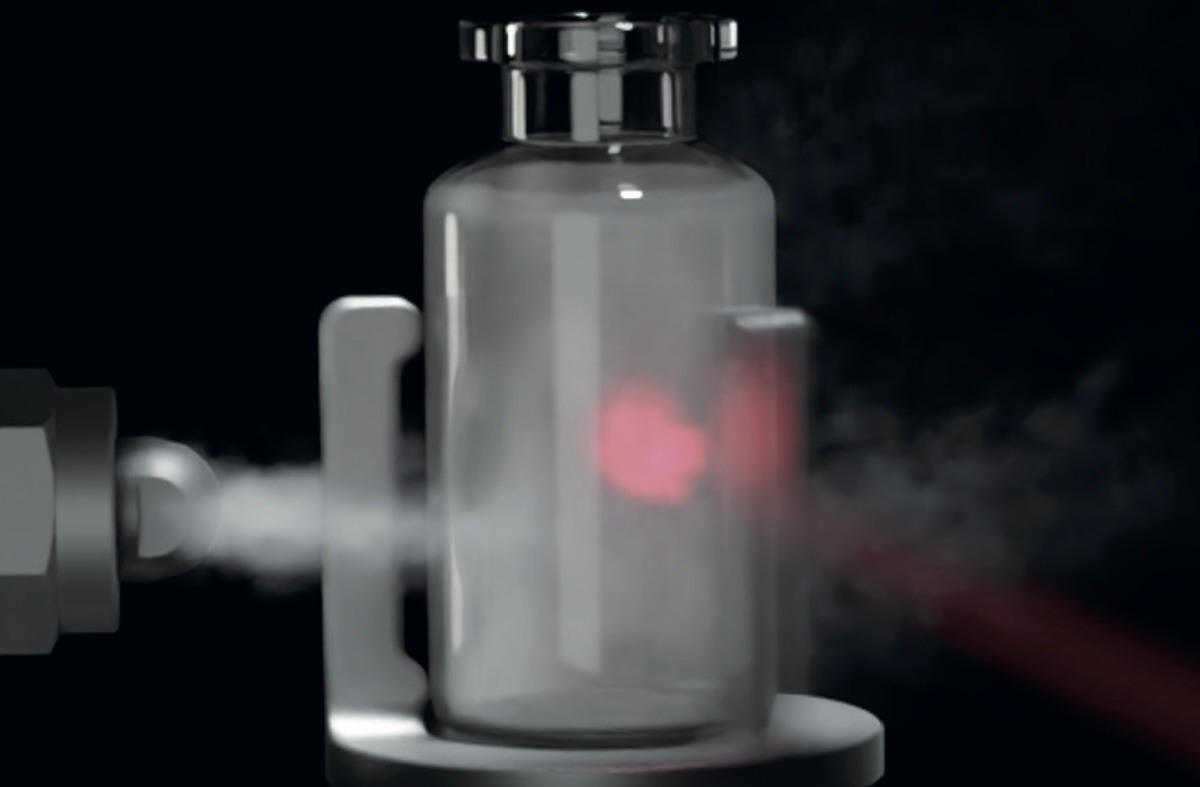
In parallel, Bayer evaluated continuous spin-freeze-drying in collaboration with Rheavita. By freezing the formulation as a thin, rotating layer and applying closed-loop temperature control during drying, the process decouples product performance from equipment-specific heat transfer effects. Each vial follows an identical thermal history, independent of scale.
Key observations from the study included:
- Spin-freezing conditions influenced cake appearance and residual moisture, but did not compromise critical quality attributes such as assay, purity, or reconstitution time.
- Annealing, often used in batch freeze-drying, produced unexpected negative effects, including skin formation and increased product resistance—highlighting that batch-era assumptions do not always translate to continuous processes.
- Stability outcomes were dominated by formulation composition rather than freezing parameters, reinforcing the robustness of controlled continuous drying .
What This Means for Peptide Drug Development
This case study underscores a broader point: continuous freeze-drying is not merely a faster alternative to batch lyophilization. It reshapes the development workflow by stabilizing the process early, simplifying transfer, and allowing teams to focus on formulation science instead of repeatedly compensating for equipment differences.
For peptide drug products—especially those targeting complex delivery routes like inhalation—this level of control can translate into faster development, lower risk, and smoother progression from early studies to clinical supply.
The Bayer experience adds to a growing body of evidence that continuous spin-freeze-drying is not a future concept. It is a practical, data-backed manufacturing strategy already delivering value in real development programs.




-1.png)
-2.png)